
Soaring prices for electricity, water and fuel have triggered protests amid concern that politicians are mishandling Ghana’s economic downturn
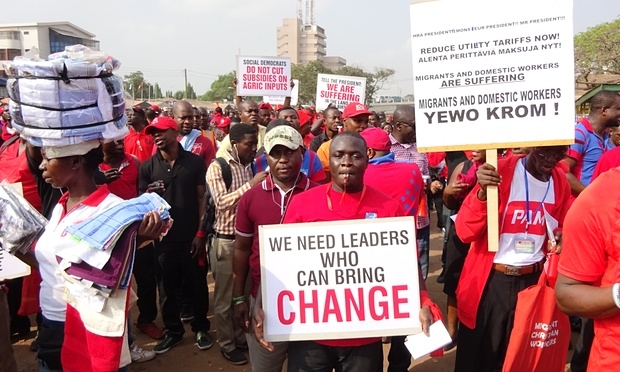
Dressed in the red and black clothing traditionally worn at funerals, waving anti-austerity placards and accompanied by drums and bellowing horns, thousands of Ghanaians descended on the Kwame Nkrumah Circle in Accra in mid-January.
These workers marching through the capital and other cities were showing their dismay at recent price hikes and taxes, which have increased the cost of electricity by 59%, water by 67% and fuel by 28%.
Ebenezer Pabi, a warehouse keeper at an import company for 17 years, says prices are making life in the west African country very difficult.
Ghana’s cocoa farmers turn to smuggling as profits dwindle
Read more
“The government is raising things and the living standard in Ghana is hard. Money is not flowing in the system and it is a problem,” the 39-year-old father of two explains. At the end of last year, inflation in Ghana was running at 17.7%, well above the budget target of 13.7%,
“It is difficult. When my child got sick and we went to the hospital, the bill was high and even the school fees have increased – it is too much. We want the government to see how we, as workers, are suffering.”
The hardships endured by Ghana’s workforce reflect broader difficulties facing the economy as the country heads towards presidential and parliamentary elections in November.
Once an African success story built on gold, oil and cocoa, Ghana leveraged its natural resources to produce strong economic growth in the early years of this century. It met the millennium development goal of halving poverty rates by 2015, and was hailed as a model of political stability after peaceful elections.
But plummeting global commodity prices have pummelled Ghana’s economy. Export revenues for oil, gold and cocoa declined from $8.2bn (£5.8bn) between January and September 2014 to $5.8bn a year later.
Add to this a three-year electricity crisis, rising public spending and debts of 90bn cedis (£16bn) – giving Ghana a debt-to-gross domestic product ratio of more than 70% – and it is clear why one of Africa’s most stable countries is in trouble, and why political leaders are fretting about their future.
The mounting debt levels led the International Monetary Fund to introduce a $918m three-year assistance programme in April. A third payment of $114.6m was given this month and the IMF said Ghana must rein in spending to reduce debt.
Ghana’s plea to IMF a sad recognition of the perils of prosperity
Read more
The public’s anger at higher prices has been stoked by a perception that the government is mishandling the economic downturn, and mismanaging public finances. The transport minister was forced to resign in December after it emerged the government spent 3.6m cedis painting pictures of President John Mahama and former leaders on buses.
Mahama’s government, which will go head-to-head with the National Patriotic party in November, has been criticised for lavishly rewarding government officials with houses, cars and fuel in addition to generous salaries.
A 2015 Transparency International study on perceptions of perceptions of corruption in Africa (pdf) ranked Ghana second worst, behind South Africa. In October seven high court judges were suspended amid bribery allegations.
“We are unable to deal with this perception of corruption because of weak leadership,” says Professor Newman Kusi, executive director at Accra’s Institute for Fiscal Studies. “The government needs to sit down and have a proper prioritisation of government spending and put the budget in a long-term framework.”
The fuel price rise in this oil-producing country, at a time of declining global prices, also infuriated the public – and this anger could translate into lost votes for the ruling National Democratic Congress (NDC) party in November.
“Ghanaian governments have played politics with fuel prices in this country … even though the fuel price is going down, the truth is that the government is indebted to a whole range of organisations,” says Kusi.
“The debt burden has gone beyond our level and we are not surprised that the cedi is on a rundown.”
The cedi lost 18.75% in value against the dollar in 2015 and its decline, along with the introduction of a capital gains tax on all listed securities on the Ghana stock exchange, has seen foreign investor interest wane.
“It has affected business,” says Geoffrey Maison, analyst at investment bank Cal Brokers in Accra. “A lot of foreign investors pulled out of the stock market and a lot of people are now moving toward government of Ghana securities and away from the stock market. With revenues going down, we expect the government will come back to the market to borrow. If they are borrowing like they borrowed last year, we can expect interest rate levels to go up [and] inflation will be affected.”
That is unlikely to bolster the ruling party’s chances at the polls. Mahama is seeking re-election but he will not be able to hike public spending to smooth voter concerns because of the IMF programme.
A priority will be addressing the nationwide power cuts. The arrival of a power barge from Turkey in November was meant to help but the blackouts persist and have hampered productivity.
“A lot of our problems come from the power crisis,” Maison says. “A lot of people bought generators, fuel prices went up and some companies have had to shut down. It has affected us a lot. If [power] is more stable, we can have a lot more industries thriving … we can’t be dependent on our resources forever.”
As Mahama grapples with the multiple strands of the economic downturn, he will be aware that the demonstrators at Kwame Nkrumah Circle are the ones feeling the most pain – and the ones who will vote in 10 months’ time.
“We are drumming home our concerns generally,” says Kofi Asamoah, secretary general of the Trade Union Congress, “to let the public and government know how serious we are.”
AUthor: Chris Matthews in Accra for The Guardian